MBy the Maison Menashe team··5 min readBuying Guides
If you're holding a gibeon meteorite wedding band and wondering whether the pattern in it is real iron from space or a clever etch on ordinary steel, there's one test that settles it. The pattern itself tells you. You don't need a lab, just a loupe and a few minutes.
Genuine gibeon meteorite carries a structure that forms only one way, over a timescale no factory can shortcut. Once you know what that structure looks like, spotting an imitation gets easy.
Key Takeaways
The Widmanstätten pattern is the one reliable marker of real Gibeon meteorite material.
Etched steel imitations show flat, repetitive lines that look printed rather than grown.
A jeweler's loupe reveals texture differences a phone photo will hide.
Genuine gibeon meteorite typically contains 7.5 to 14 percent nickel, which is part of why the pattern forms at all.
Because a tungsten ring core cannot be resized, getting your size right before you buy matters more with meteorite inlay bands than with almost any other style.
What Is the Widmanstätten Pattern on a Gibeon Meteorite Wedding Band?
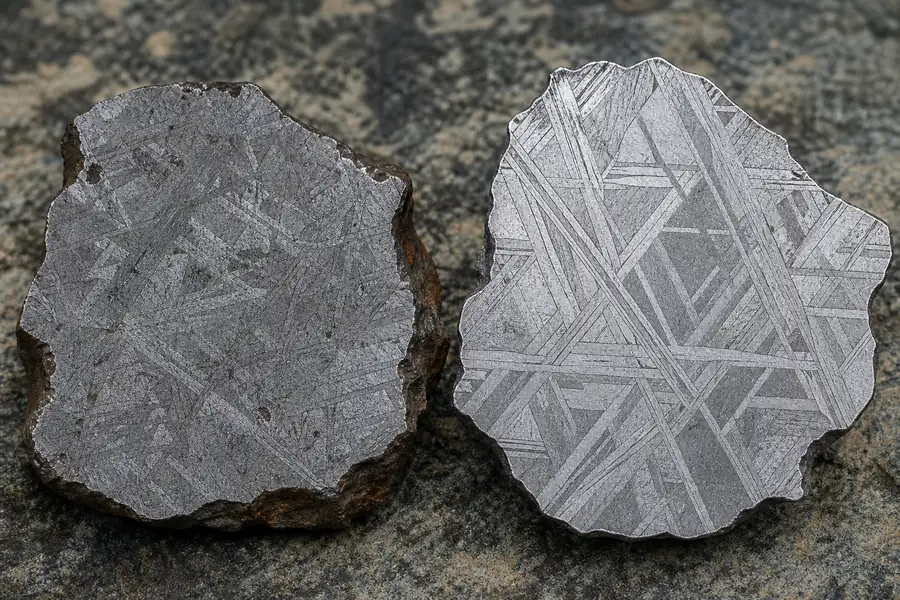
The Widmanstätten pattern is a crosshatched, geometric grain that appears when a nickel-iron meteorite is cut, polished, and etched with a mild acid. It forms because the metal cooled at roughly 1 to 10 degrees Celsius per million years while still inside its parent asteroid, letting two nickel-iron alloys, kamacite and taenite, separate into distinct, interlocking bands as the metal slowly crystallized.
That cooling rate is the whole reason the pattern can't be faked. No industrial process cools steel over a million years, so no etched steel surface can reproduce the same interlocking band structure, no matter how careful the acid work.
On a genuine gibeon meteorite wedding band, the bands cross at consistent angles, close to 60 degrees, in what's called an octahedrite structure, specific to this class of meteorite. Gibeon meteorite comes from a fall in Namibia, and slices of it show this pattern with remarkable consistency, which is part of why it has become the standard material across our meteorite wedding bands rather than a rarer, less predictable source.
How to Spot an Etched Steel Imitation Next to a Real Gibeon Meteorite Wedding Band
An etched steel imitation shows shallow, repetitive lines that look printed onto the surface rather than grown through it, because acid etching on ordinary steel just eats away surface metal with no crystalline structure underneath to reveal. Real meteorite pattern has depth and irregularity built into the metal itself; a fake pattern sits only on top.
Feature
Genuine Gibeon Meteorite
Etched Steel Imitation
Pattern origin
Natural crystal growth over millions of years
Acid-etched surface only
Line angles
Consistent, roughly 60 degree crossings
Random scratches or a uniform grid
Depth under a loupe
Visible texture, not just surface marks
Flat, printed appearance
After light resurfacing
Pattern remains, since it runs through the metal
Pattern disappears or fades
The last row is the most useful test if a jeweler is willing to run it: a light re-polish on genuine meteorite brings the pattern back once it's re-etched, because the structure runs all the way through the slice. On steel, polishing removes the pattern for good, since there was never anything underneath it.
Simple Tests You Can Do at Home on a Gibeon Meteorite Wedding Band
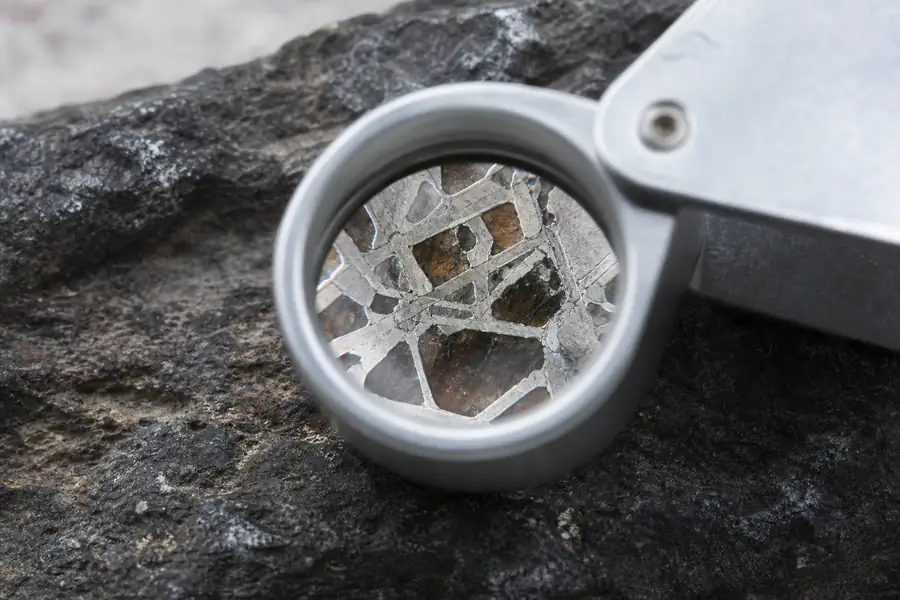
A 10x jeweler's loupe is the single most useful tool for checking a gibeon meteorite wedding band yourself, and it costs less than a dinner out.
Loupe check: real pattern shows raised, slightly uneven bands; fake pattern looks like ink on a flat surface.
Angle test: tilt the ring under a lamp. Genuine crystal facets catch and lose light unevenly as you turn it; a printed pattern reflects the same everywhere.
Reference comparison: compare against published photos of gibeon meteorite slices. Real pattern is irregular in width from band to band, never perfectly uniform.
Ask for sourcing: a jeweler selling genuine material should be able to tell you it's gibeon meteorite specifically, not a generic label like meteorite alloy or space metal.
Choosing a Gibeon Meteorite Wedding Band You Can Trust
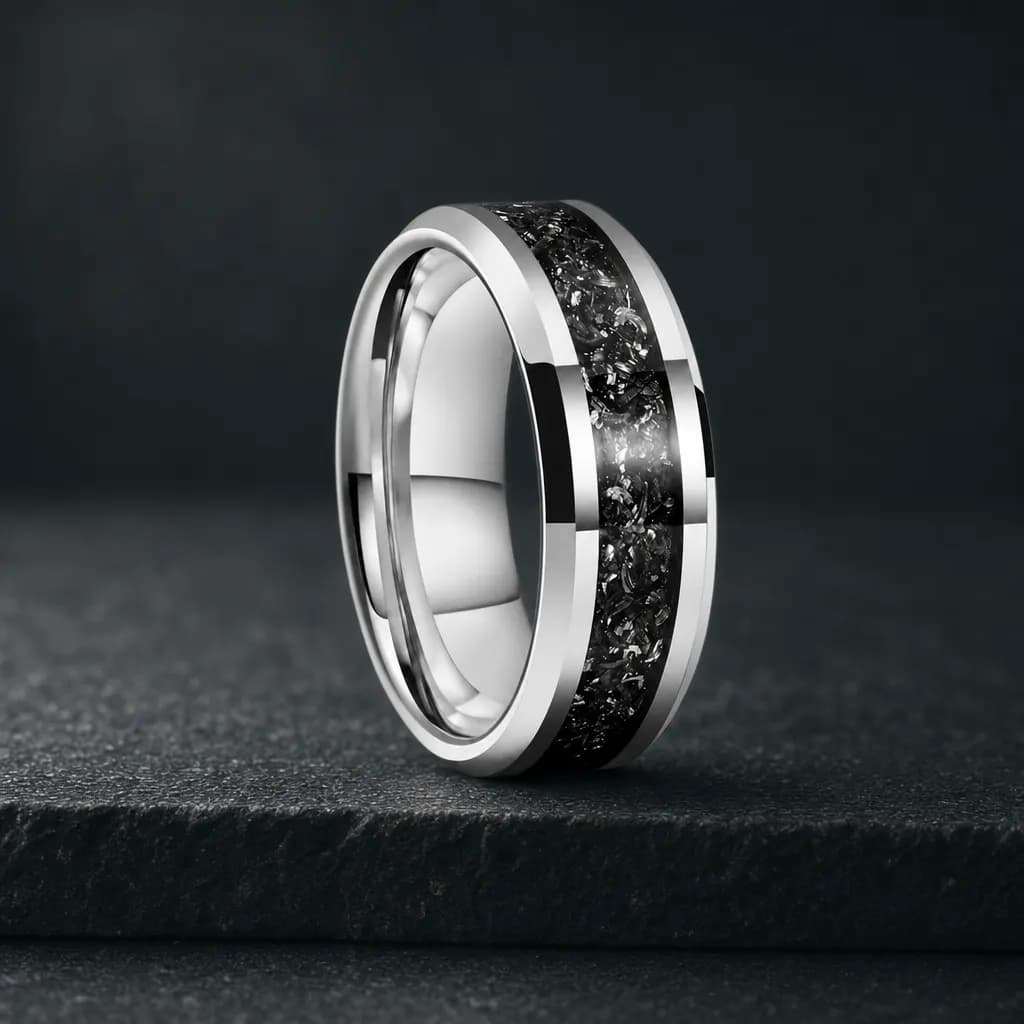
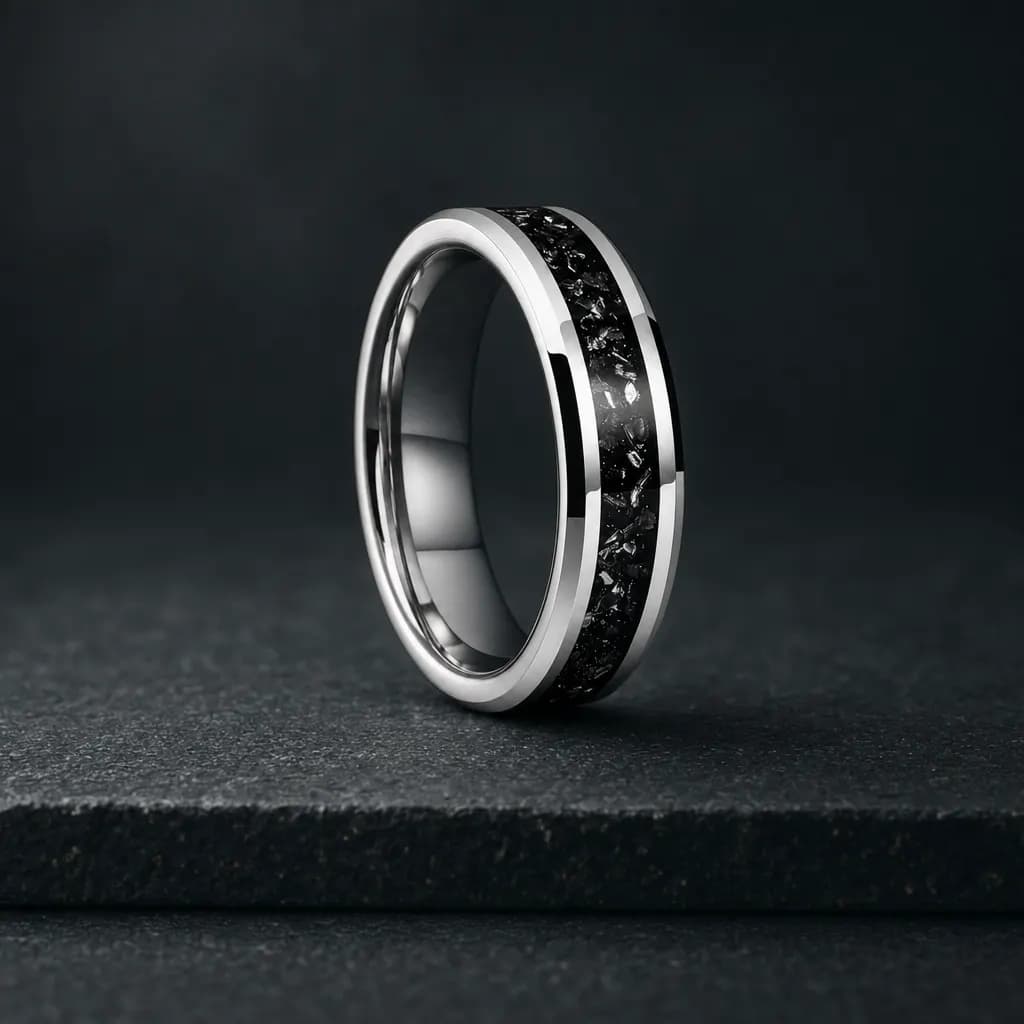
Buying from a maker who states plainly where the material comes from saves you the guesswork later. The Vulcan pairs a genuine gibeon meteorite inlay with a tungsten carbide core, so you get the pattern without the softness of a full meteorite band, since raw meteorite alone is far too brittle and porous to wear daily on its own.
That tungsten core is also the honest trade-off worth knowing before you order: it cannot be resized once it's made. Confirm your measurement against the guide on ring sizing before you check out, or start from a proven shape in the best sellers if you're not sure what width or profile suits your hand.
FAQs
Can a real Gibeon meteorite ring lose its pattern over time?
No. The Widmanstätten pattern runs all the way through the metal, not just on the surface, so normal wear, light scratches, or a professional re-polish will not erase it. A jeweler can even re-etch the surface to bring the pattern back into sharper contrast if it dulls.
Why can't jewelers just fake the pattern with acid on steel?
Acid etching only removes surface metal; it cannot create the internal crystal bands that form when nickel-iron cools for millions of years inside an asteroid. The result on steel is a flat, repetitive pattern that looks printed rather than grown, and it disappears completely if the surface is polished down.
Does every meteorite wedding band use Gibeon meteorite specifically?
Not always. Gibeon meteorite, from a fall in Namibia, is the most common source because its Widmanstätten pattern is unusually consistent, but some sellers use other iron meteorites or blend material. Ask your jeweler directly which meteorite the ring uses and expect a specific answer, not a vague one.
Is a Gibeon meteorite inlay ring safe to wear every day?
The meteorite itself is thin and set into a durable core, usually tungsten carbide, rather than worn as a solid meteorite band, since raw meteorite is brittle and can corrode if exposed to moisture without sealing. With a solid core underneath, the inlay handles daily wear well as long as you avoid prolonged water exposure and harsh chemicals.
About this guide
Written by the Maison Menashe team against the rings we actually stock. Specifications quoted here, including widths, thicknesses and materials, are taken from our own catalogue rather than from a supplier sheet.
We sell these rings, which is a bias worth knowing about when you read us. We try to earn the benefit of the doubt by stating the limitations plainly, including the ones that cost us sales: tungsten carbide cannot be resized, and a black finish is a coating that wears at the contact points over years.