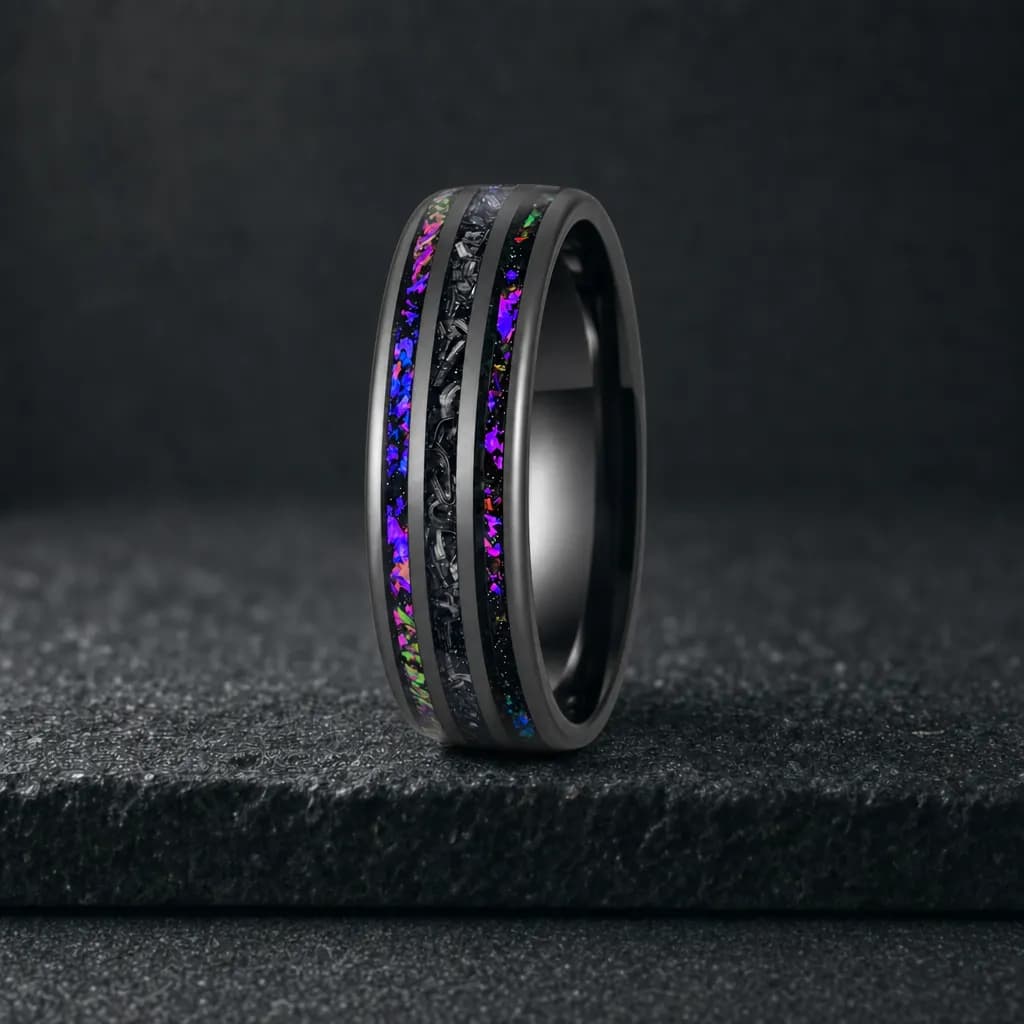
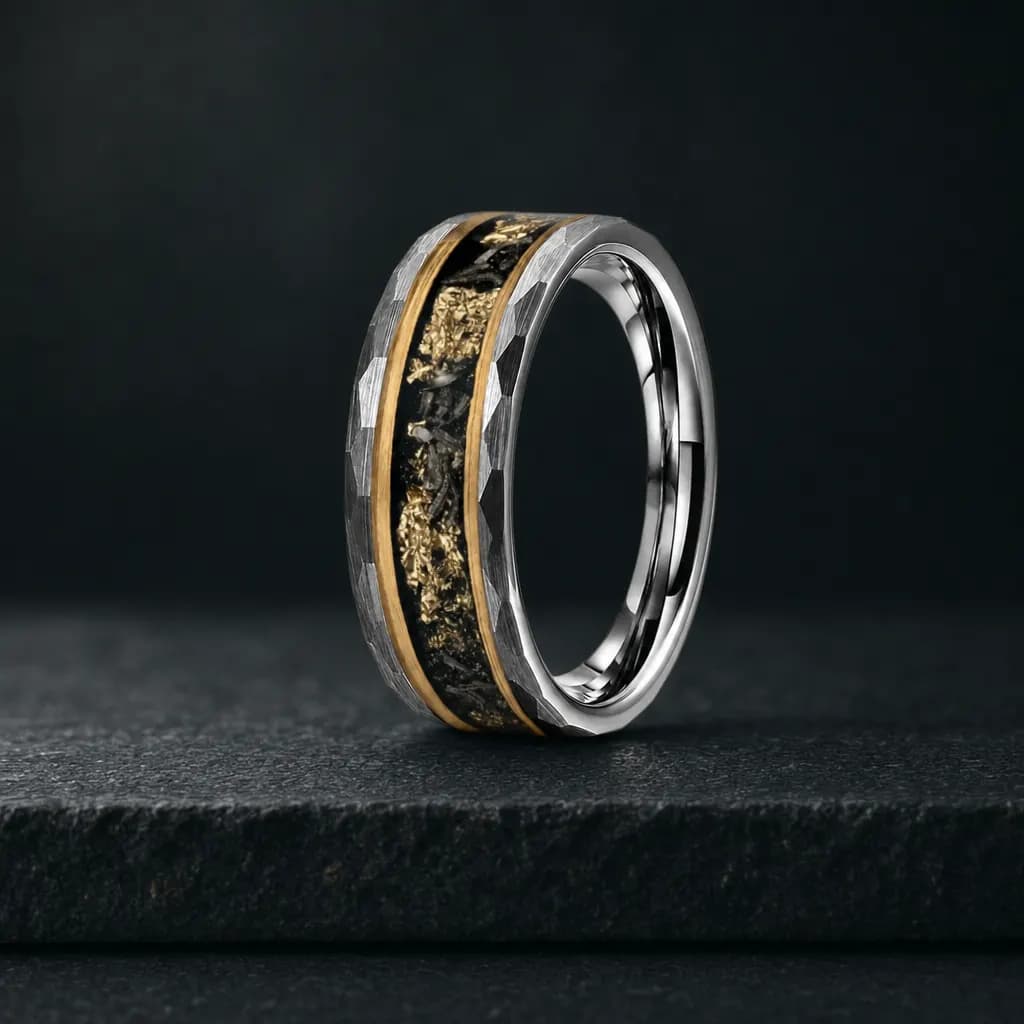
Meteorite Wedding Bands: What Gibeon Meteorite Actually Is
MBy the Maison Menashe team··6 min readMaterials & Craft
A meteorite wedding ring carries a pattern no jeweler can etch by hand and no factory can replicate. That pattern comes from Gibeon meteorite, an iron-nickel fragment that formed inside a shattered asteroid core long before Earth existed. Knowing what the material actually is, and why it never makes up the whole band, tells you what you're really buying.
Gibeon meteorite is an iron-nickel meteorite found in Namibia, classified by metallurgists as a fine octahedrite.
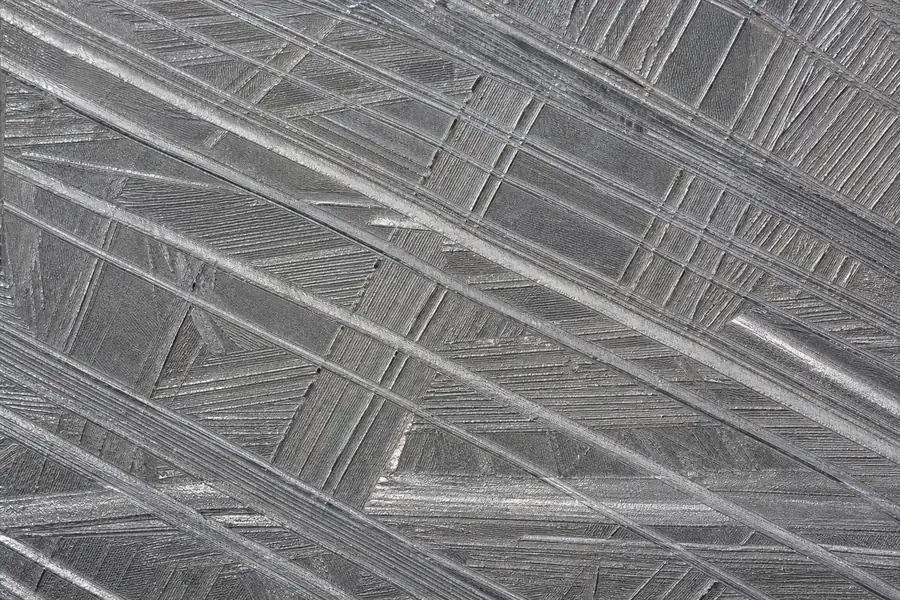
Its banded Widmanstätten pattern forms only through cooling rates of roughly 1 to 10 degrees Celsius per million years inside an asteroid core, a process no factory can reproduce.
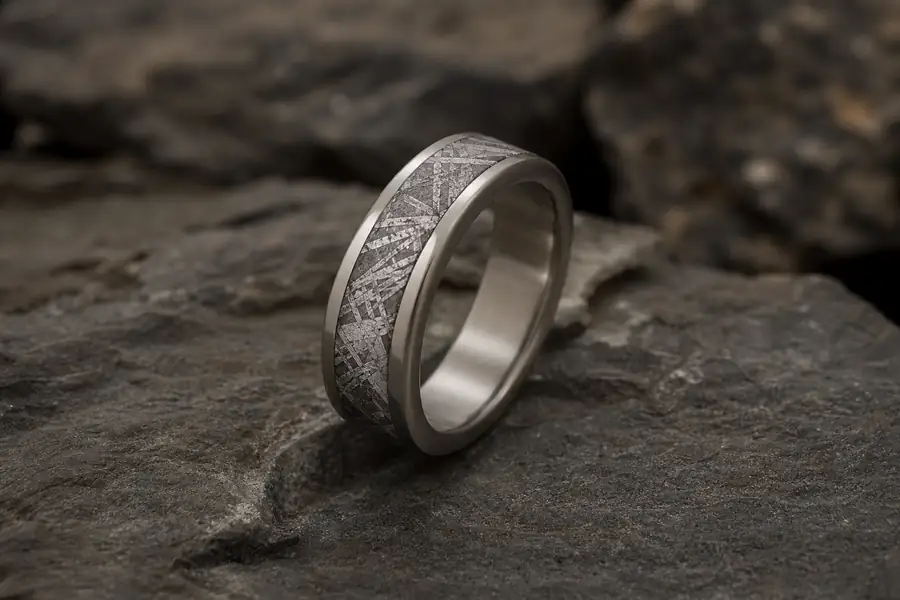
Because meteorite is brittle and prone to oxidation, a meteorite wedding ring sets it into a channel within a harder metal, not across the entire band.
Meteorite inlays are sealed with a stabilizing resin to stop the iron content from rusting.
Like solid tungsten carbide, a meteorite wedding ring typically cannot be resized once the frame is finished.
What Is Gibeon Meteorite, and Why Does It End Up in a Meteorite Wedding Ring?
Gibeon meteorite is an iron-nickel meteorite that fell over what is now Namibia in prehistoric times, breaking apart into fragments scattered across a wide strewn field long before modern collectors found it. Metallurgists classify it as a fine octahedrite, a category defined by the width of the metal bands running through the fragment. The material runs roughly 90 percent iron and 8 percent nickel, with trace cobalt and phosphorus, which is what gives it a dense, dark grey surface unlike any terrestrial alloy.
Jewelers use Gibeon meteorite specifically because slicing and acid-etching a fragment reveals a crystalline structure that nothing manufactured can copy. It's the material behind nearly every ring in our meteorite wedding bands collection, chosen over other meteorite types because it etches cleanly and holds its pattern well once sealed and set.
The Widmanstätten Pattern: A Structure Earth Cannot Make
The Widmanstätten pattern is the crosshatched, banded texture visible once a slice of iron-nickel meteorite is cut, polished, and etched with acid. It forms only when molten iron-nickel cools at an extremely slow rate, on the order of 1 to 10 degrees Celsius per million years, buried deep inside the core of an asteroid that later broke apart.
That cooling rate needs a mass of insulating rock and metal the size of a small planetary body, sustained for a stretch of time longer than complex life has existed on Earth. No furnace, kiln, or lab setup can hold a controlled cool for a million years, so the pattern cannot be grown, printed, or faked in a workshop. Anything genuinely showing a Widmanstätten pattern was cut from an actual meteorite, and that fact alone is what separates real meteorite jewelry from a metal ring with a printed finish.
Why Meteorite Is Set in a Channel, Not the Whole Band
A meteorite wedding ring sets a thin slice of Gibeon meteorite into a channel cut into a harder metal, rather than forming the whole band from meteorite, because the material on its own is too brittle and too reactive for daily wear. Iron-nickel meteorite is noticeably softer than tungsten carbide and prone to hairline cracking under the kind of knocks a ring takes against tools, car doors, and gym equipment. It also rusts, since the iron content oxidizes when it meets moisture and skin oils over time, which is why a meteorite inlay is sealed with a stabilizing resin before it's ever set.
Setting the meteorite into a channel within a tungsten carbide or titanium frame solves both problems at once. The harder metal absorbs the daily impact, the resin keeps the meteorite sealed against moisture, and the channel supports the fragile material on both sides instead of leaving it exposed at the edge. The Eclipse pairs a Gibeon meteorite inlay with a tungsten carbide edge for this exact reason, and it sits inside our Forge Edge collection of rings that combine a hard metal frame with a contrasting inlaid material.
Caring for and Resizing a Meteorite Wedding Ring
A meteorite wedding ring cannot be resized once it's finished, the same limitation that applies to solid tungsten carbide bands. Cutting or stretching the metal frame to change the size would crack the meteorite inlay or fracture the channel holding it in place. That's worth saying plainly rather than glossing over: get your size confirmed before you order, using a printable sizer or a ring you already own as reference, the method we walk through on our ring sizing page.
The same brittleness that calls for a channel setting is also why tungsten carbide rings in general cannot be resized, a trade-off explained in full on our page about why tungsten rings cannot be resized. Day to day, keep a meteorite wedding ring away from harsh chemicals and prolonged water exposure, which can work past the resin seal over the years and dull the inlay's finish. A soft cloth wipe after wear is enough for the metal frame, and an ultrasonic cleaner should stay away from the meteorite section itself.
If a ring still turns out wrong, wrong size, wrong style, or damaged beyond fair wear, Maison Menashe replaces it once free under the ring replacement program. Honesty about a material's limits costs nothing when the fix is already built in.
FAQs
Is a meteorite wedding ring real meteorite or a printed pattern?
A genuine meteorite wedding ring uses an actual slice of iron-nickel meteorite, usually Gibeon meteorite, cut and acid-etched to reveal the Widmanstätten pattern. No printing or engraving process can reproduce that crystal structure, so a real ring always starts from meteorite material rather than a photographic finish on plain metal.
Will a meteorite wedding ring rust?
The exposed meteorite inlay can rust if the sealing resin wears away and the iron content meets consistent moisture, so it's coated before it's ever set. Wiping the ring dry after swimming or heavy sweating and avoiding harsh chemicals keeps that seal intact for years.
Can you resize a meteorite wedding ring?
No. Meteorite wedding rings cannot be resized once the frame is finished, because reshaping the metal would crack the brittle inlay inside it. Get an accurate size before ordering, since a different size later means a replacement ring rather than an adjustment.
What metal is used for the band around the meteorite?
The frame is typically a harder metal such as tungsten carbide or titanium, chosen because it absorbs daily impact without transferring stress to the fragile meteorite. The meteorite sits inlaid in a channel rather than forming the ring's structural body.
How can you tell if a meteorite wedding ring is genuine?
Genuine Gibeon meteorite shows a fine, irregular crosshatch pattern with bands that vary slightly in width and angle across the surface, unlike a printed or laser-etched imitation that repeats too evenly. Buying from a seller who states the meteorite's source and backs the ring with a warranty is the more reliable check.
About this guide
Written by the Maison Menashe team against the rings we actually stock. Specifications quoted here, including widths, thicknesses and materials, are taken from our own catalogue rather than from a supplier sheet.
We sell these rings, which is a bias worth knowing about when you read us. We try to earn the benefit of the doubt by stating the limitations plainly, including the ones that cost us sales: tungsten carbide cannot be resized, and a black finish is a coating that wears at the contact points over years.