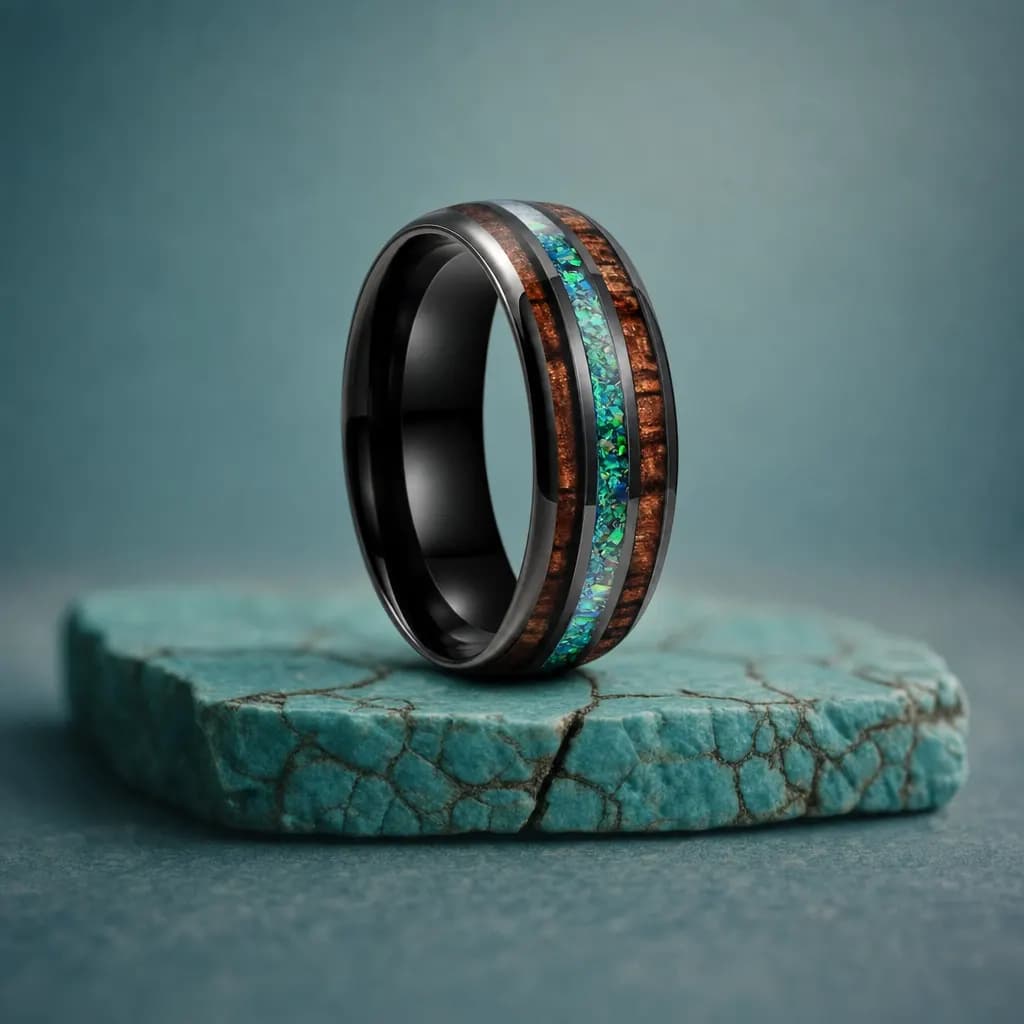
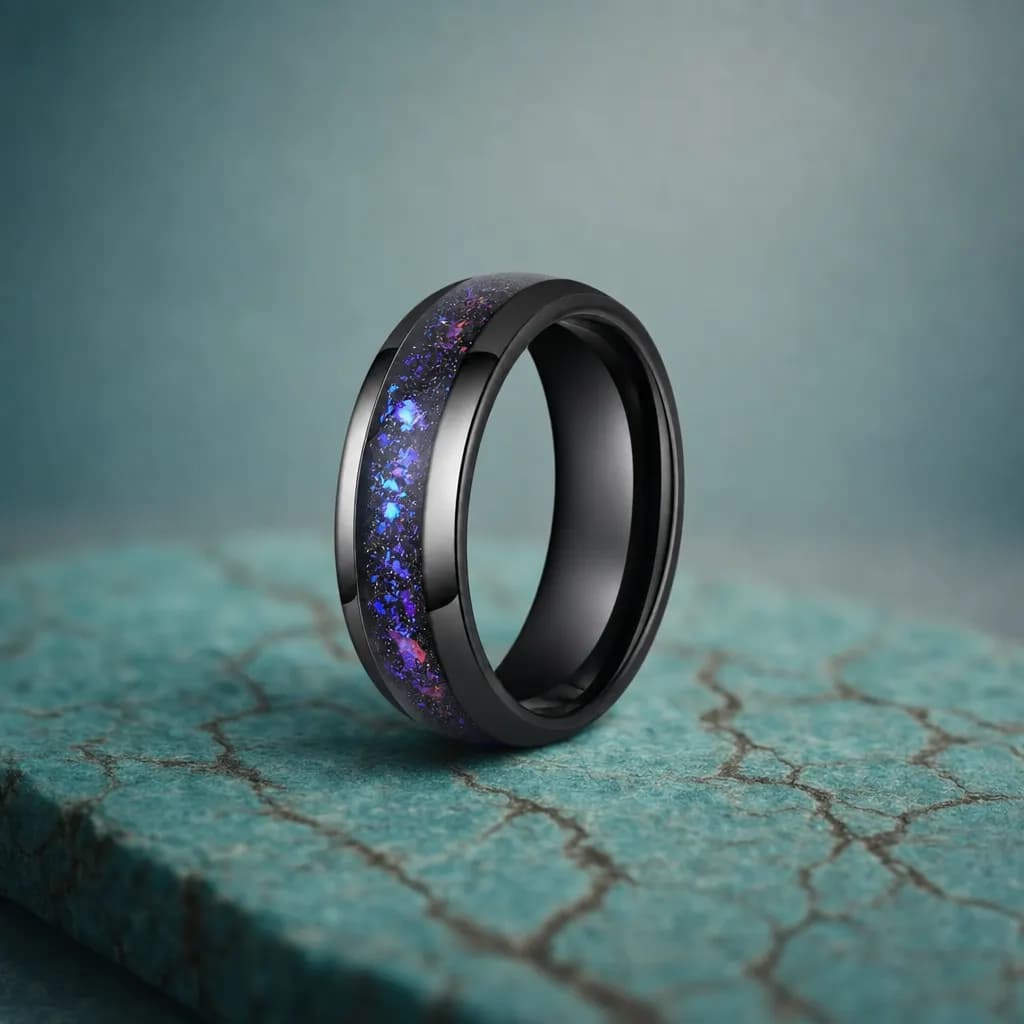
Black Opal Wedding Rings: Why the Dark Base Changes Everything
MBy the Maison Menashe team··7 min readStyle & Design
Opal has a reputation problem among men shopping for a wedding ring. It looks bright and iridescent, closer to a stone you'd expect on a cocktail ring than on a band you wear to work every day. That reputation comes almost entirely from how opal is usually set, against white gold or pale mother-of-pearl, where the stone's color washes out into something pastel and delicate. Set the same opal against a black base and the read changes completely: the color intensifies, the stone looks darker and more graphic, and the ring reads as something built for a man's hand rather than borrowed from somewhere else.
Here is why the dark base does that work, and what black opal wedding rings actually look like once you take them outside.
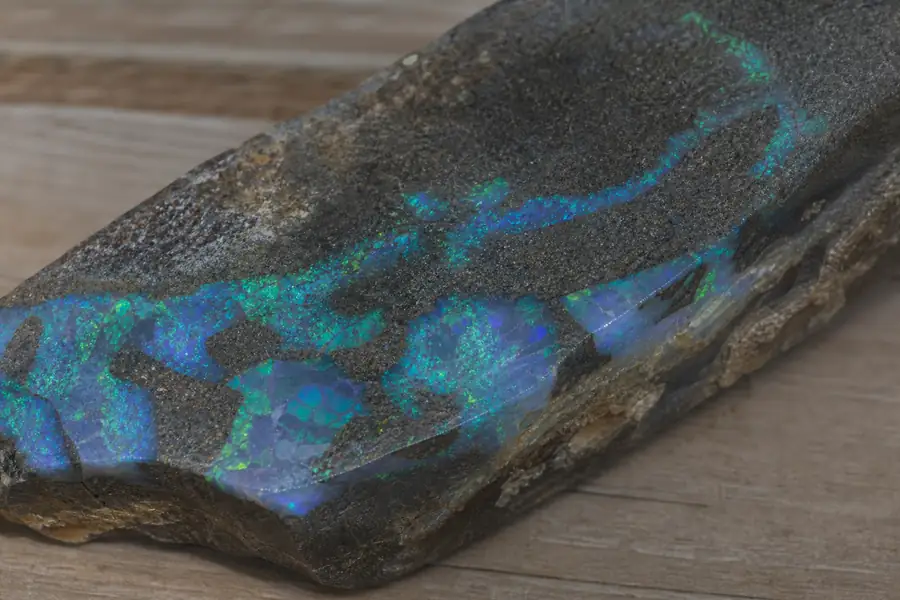
A black base intensifies opal's play-of-color (the flashes of spectral color inside the stone) instead of muting it the way white gold or silver does.
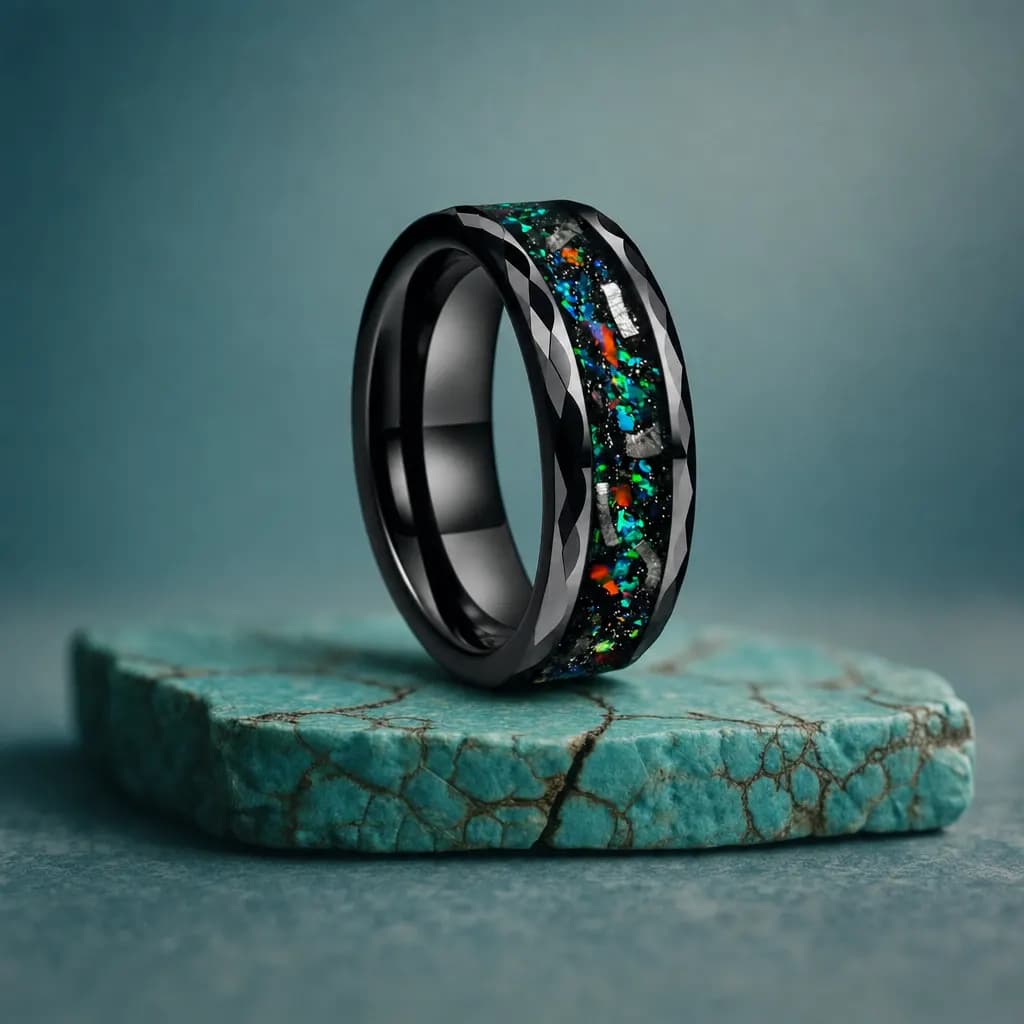
Black opal wedding rings read as graphite, charcoal, or deep blue-green in normal light, with color flashes appearing mainly at certain angles.
The dark base keeps the ring's base tone low-key and masculine even when the opal itself is doing something dramatic.
Photographs flatten opal. It looks different in direct sun, in shade, and under indoor light, and no single photo shows all three.
Opal is soft, roughly 5.5 to 6.5 on the Mohs scale, so it needs a protective setting rather than sitting exposed on the band's surface.
Because the base metal is usually tungsten carbide, black opal wedding rings cannot be resized after the fact, so getting your size right before you order matters more than usual.
Why a Black Base Makes Black Opal Wedding Rings Read Stronger
A black base makes the play-of-color in opal look brighter and more saturated, not because the color itself changes, but because nothing is bouncing light back to compete with it. Play-of-color happens when microscopic silica spheres inside the opal diffract light into flashes of spectral color as the stone moves. Set against a white or pale backing, ambient light reflects back up through the stone from behind, and that reflected light dilutes the flashes into something soft and pastel.
Set the same stone against a black backing, and there is nothing behind it to reflect light forward. Only the diffracted color that the opal itself produces reaches your eye, against a dark void instead of a wash of white light. The result is color that looks deeper, more contrasted, and considerably less pastel than the same opal set in white gold.
Why Black Opal Wedding Rings Suit a Man's Hand
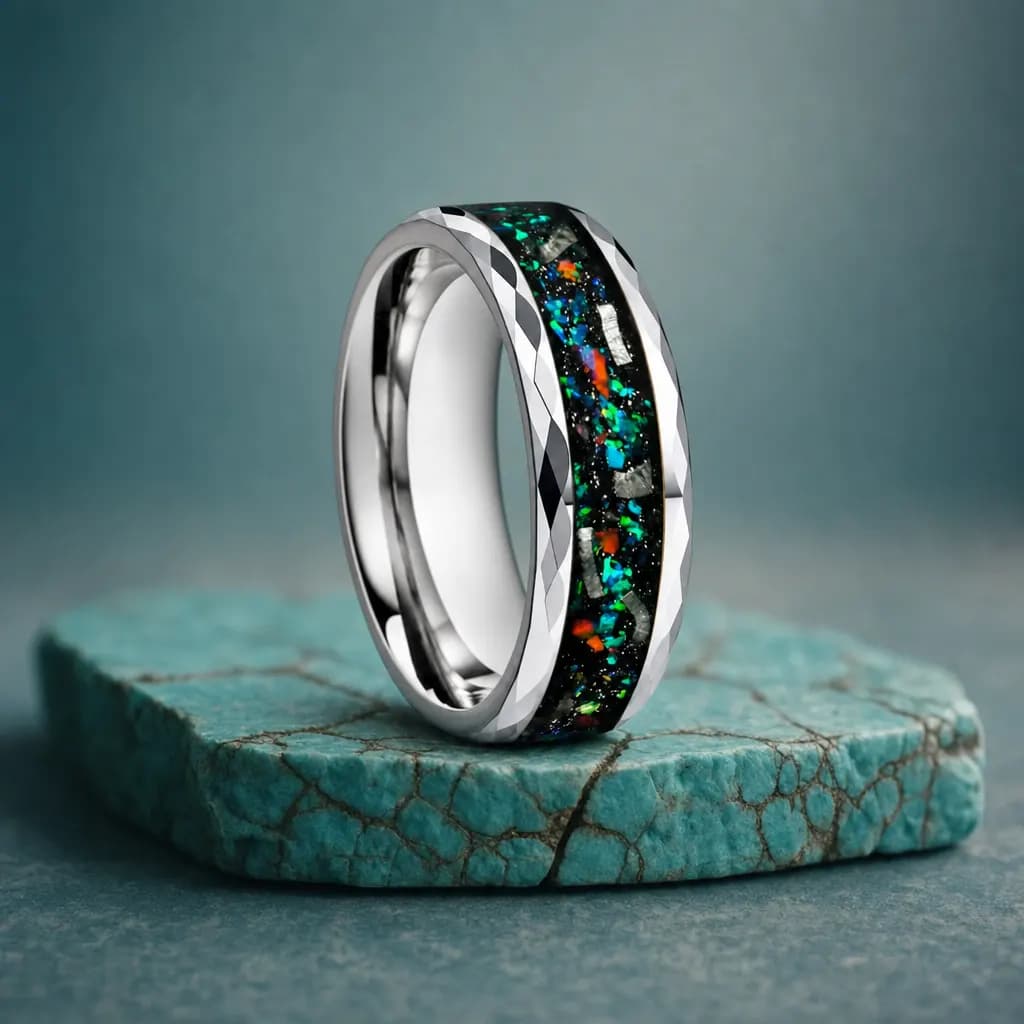
Black already reads as one of the more common base colors in men's wedding jewelry, which is part of why black opal wedding rings don't feel like a departure the way a pale opal ring might. Browse the black wedding bands collection and you'll notice the same principle at work even without opal involved: a dark base tone reads as understated at a glance, no matter what detail is happening on top of it.
On a woman's ring, opal is often the entire point, cut large and set high so the color dominates. On a men's band, the black base is what your eye registers first. The opal becomes an accent that shows itself in certain light rather than the whole story. The Aurora is a good example of that balance: a black tungsten base carries an opal inlay set low into the band, so the color flashes only when the light catches it and stays quiet the rest of the time.
How Black Opal Wedding Rings Look in Different Light
Black opal wedding rings change appearance noticeably depending on the light around you, which is exactly what a single product photo cannot show. A photo captures one moment under one light source. Your hand, moving through a normal day, passes through several.
Light condition
What you actually see
Direct sunlight
Full-spectrum flashes of green, blue, and orange move as your hand turns; the black base almost disappears under the color
Open shade or overcast
Color calms to blue-green and violet, and the base reads as flat matte black
Warm indoor light
Orange and red flashes come forward; the base looks near-black with a soft sheen
Cool LED or fluorescent light
Flashes shift toward blue and green, and the contrast between color and base is sharpest
Photographed
Flattens to one dominant color and loses the movement, since a photo shows a single instant, not the range you see in person
That range is the actual selling point of black opal wedding rings. The stone is not one fixed color, it is a stone that reads differently depending on where you are standing, which is precisely why photos undersell it.
What to Know Before You Order Black Opal Wedding Rings
Opal at roughly 5.5 to 6.5 on the Mohs scale is considerably softer than the tungsten carbide it's typically paired with, which sits near 9. That gap is why opal is inlaid into a recessed channel rather than left standing proud of the band's surface, where an edge knock could chip it. Pieces in the Forge Edge collection use that recessed approach to protect the stone edge while still letting the color show from most angles.
Here's the honest trade-off: because the base underneath the opal is tungsten carbide, tungsten rings cannot be resized once they're made. That's true of black opal wedding rings the same as any tungsten band. The stone is set into the metal, and there's no cutting and re-soldering a material this hard without destroying it.
That makes getting your size right before you order more important than with a softer metal you could adjust later. Take a few minutes with our guide to ring sizing before you buy, especially if this will be your first tungsten band. If you want to see how a black base pairs with other finishes before committing, the best-sellers collection is a reasonable place to start comparing.
FAQs
Do black opal wedding rings look too flashy for daily wear?
No. The black base is what your eye registers most of the time, and the opal's color only shows strongly at certain angles and in brighter light. In normal indoor conditions the ring reads as a dark, understated band with occasional flashes of color rather than a constantly bright stone.
Can black opal wedding rings be resized?
No. The base metal in these rings is almost always tungsten carbide, which is too hard to cut and reshape without damaging the ring, so resizing isn't possible once the ring is made. Getting an accurate measurement before you order is the only way around this, which is why sizing guidance matters more with tungsten than with softer metals.
Is opal too soft for a ring you wear every day?
Opal is softer than the tungsten carbide base it's usually set into, roughly 5.5 to 6.5 on the Mohs scale compared to tungsten's 9, so it needs a protective setting rather than sitting exposed. When the stone is inlaid into a recessed channel, the surrounding metal takes the impact from daily knocks and the opal stays shielded.
Why does my black opal ring look different in every photo I've seen online?
Opal's color comes from light diffracting through microscopic structures inside the stone, so the exact flashes you see depend on the angle of the stone and the light source in that moment. A photo captures a single instant under one light, while your eye sees the color shift continuously as your hand moves, which is why no two photos of the same ring look identical.
What metal is typically used for the black base on these rings?
The black base on most opal wedding rings is tungsten carbide, often finished with a black coating or treatment to achieve the dark tone. Tungsten carbide is chosen for its hardness and scratch resistance, which helps protect the softer opal inlay set into it.
About this guide
Written by the Maison Menashe team against the rings we actually stock. Specifications quoted here, including widths, thicknesses and materials, are taken from our own catalogue rather than from a supplier sheet.
We sell these rings, which is a bias worth knowing about when you read us. We try to earn the benefit of the doubt by stating the limitations plainly, including the ones that cost us sales: tungsten carbide cannot be resized, and a black finish is a coating that wears at the contact points over years.